Archive for the 'Journals' Category

Honoring Women’s History Month

In honor of National Women’s History month, I would like to honor someone whose writing has changed my life. Her name is Anais Nin.

Anais Nin was many things to many people: friend, confidant, lover, author, philosopher, psychologist, and diarist. In many ways she was a Renaissance woman, interested and interesting in many areas. As a French-Cuban author, she was best known for her published journals that spanned 60 years. Like myself, a traumatic event turned her onto writing. When she was 11 years old, her father left the family for a younger woman. Her journals began as a letter to him and as time went on those pages became her best friend, confidant, and a crucial part of her everyday life. Here’s what she said about her diary: “[It] deals always with the immediate present, the warm, the near, being written at white heat develops a love of the living moment. One thing is very clear—that both diary and fiction tend toward the same goal: intimate contact with people, with experiences, with life itself.”

In addition to journals, she also dabbled in writing novels, shorts stories and erotic literature. For a times she also busied herself with psychotherapy, inspired by and working under Otto Rank, who had worked with Sigmund Freud.

What makes her work so appealing to women is that she provides profound insights into her own role as a woman, a sexual being and erotic spirit. This helps other women define themselves and understand who they have always wanted to become. Her written voice is powerful and compelling and the fictional female characters she created are quite strong. She was not a feminist, although I have heard that she was often invited to speak at feminist rallies and events.

My dear friend, Tristine Rainer, a powerful and accomplished woman in her own right (see her website– http://www.storyhelp.com/tristine.html” was Anais’ friend and protegee and their relationship left an indelible mark on Tristine. Often at lunch, Tristine will quote what Nin would have said or done in a given situation. Recently, I had asked Tristine to share the most important thing she learned from Nin, and she said “I learned that a crazy young woman in her twenties can become a joyful, wise woman in her sixties. It was her [Nin’s] belief that we can transform ourselves and our lives through self-creation. And that diary writing was a way.”

Some of my favorite thoughts from the writings of Anais Nin:

Life shrinks and expands in proportion to one’s courage.

We don’t see things as they are, we see them how we are.

Passion gives me moments of wholensss.

Group activities weaken our will. They may be a solace to loneliness, but they do not foster the individual creative will.

The role of a writer is not to say what we can all say, but what we are unable to say.

We write to taste life twice, in the moment, and in the retrospection… We write to be able to transcend our life, to reach beyond it. We write to teach ourselves to speak with others, to record the journey into the labyrinth.

There were always in me, two women at least,
one woman desperate and bewildered,
who felt she was drowning and another who
would leap into a scene, as upon a stage,
conceal her true emotions because they
were weakness, helplessness, despair,
and present to the world only a smile,
an eagerness, curiosity, enthusiasm, interest.

While an MFA student at Spalding University, I rediscovered Nin in the course of my research on diaries and their healing and cathartic benefits. Because a traumatic event triggered or set the platform for both of our writing careers, her story resonated with me. Furthermore, I admired the candor with which she wrote. Her words strongly embodied her deepest sentiments, so much so that the reader experiences similar feelings. When I wrote my first poetry book, I dedicated the book to her and called it, Dear Anais: My Life in Poems for You. My introduction which includes a letter to Nin, finishes like this: “You have taught me the intrinsic value of the written word, how to dig deeper into my emotional truth, and the importance of having love in my life. And for this I thank you.”

And thank you to all the women out there who have, through their good works, empowered the lives of other women. For more information on National Women’s History Month, check out this link:

http://womenshistorymonth.gov/


READERS
: I would also love to hear which woman has inspired you in your own life and/or career…

The Spiritual Experience of Eating

After the holidays many of us are complaining that we ate too much and not only did we eat too much, but too much of the wrong things.

I often suggest food journaling to ascertain the circumstances under which we eat. It has worked for me before and it can be very revealing. Sometimes we eat unconsciously and do not even know we are doing it!

If you decide to food journal and notice that you are eating too much and/or too often there is something else you can try. In the recent issue of The Soul/Body Connection, there was a great article, “How to Make Every Bite a Spiritual Experience” by Jean L. Kristeller, PhD. The exercises in the article were once shared with me at a seminar discussing the healing power of writing.

The idea is that journaling in combination with mindfulness while eating can make for a delicious experience. The article discusses how we can bring joy and balance back into our relationship with food. It is mostly about slowing down and savoring each bite. If you take time to watch slim individuals in restaurants eat, you will note, in general, how slow they eat and how many times they chew each piece of food. Another thing they do is that they often leave something on the plate and do not finish everything.

The author calls her approach the Mindfulness-Based Eating Awareness Training and she says that it does cut down on binging. She discusses a few meditations around eating, but the first one is called, “The Experience of Hunger.” In this meditation, she suggests shortly before a meal and for one minute, to stop and focus your attention on your breath, in the same way you might in a normal meditation practice. She then suggests you rate your hunger on a scale of 1 to 7 (7 the hungriest). The idea is to identify if you really need to eat or is it emotional or impulsive eating which is driving you to the food. Then you should think about how you will handle the foods and while eating, stop every few minutes to reassess your hunger and see if it is increasing or decreasing.

Food addiction is an increasing problem in the United States. In my forthcoming collection, Writers on the Edge: 22 Writers Speak About Addiction and Dependency, Margaret Bullitt-Jonas does a fine job sharing her own journey in her essay, “Putting Down the Duck,” which is an excerpt of her memoir, Holy Hunger: A Memoir of Desire.

Tribute to John Lennon — 31 years later …

(October 9, 1940 – December 8, 1980)

Last week celebrated the 31st anniversary of John Lennon’s death. As a hippie of the 1960s, who danced and made love to his music all day and night, my memories of his essence and songs will live with me forever. Like the rest of America, I remember seeing him first appear as part of the Beatles on the Ed Sullivan Show in 1965. There was something about the music, which resonated with everyone, and the proof is that The Beatles were one of the most successful commercial groups in the history of popular music. What is even more interesting is how the lyrics can continue to resonate in your head even this many years later. Lennon had an edge to him and perhaps it was his rebellious nature, politically, socially and musically which really resonated with many of us. Rolling Stone Magazine rated him the 5th greatest singer of all time. As what you might expect from a man with five sisters, he really understood women and his relationship with Yoko Ono is one, which many of us admired.

I just finished a few pages in my journal dedicated to Lennon and the powerful influence he had in my life. In addition to loving his music, I have another connection with Lennon. My last boyfriend, before getting married lived in the Dakota, and I know exactly where he got shot by Mark David Chapman. But that’s another story…
Check out this You-Tube of Lennon and one of my favorite songs of his: IMAGINE…

Here are the lyrics:

IMAGINE
Imagine there’s no heaven
It’s easy if you try
No hell below us
Above us only sky
Imagine all the people
Living for today…
Imagine there’s no countries
It isn’t hard to do
Nothing to kill or die for
And no religion too
Imagine all the people
Living life in peace…
You may say I’m a dreamer
But I’m not the only one
I hope someday you’ll join us
And the world will be as one
Imagine no possessions
I wonder if you can
No need for greed or hunger
A brotherhood of man
Imagine all the people
Sharing all the world…
You may say I’m a dreamer
But I’m not the only one
I hope someday you’ll join us
And the world will live as one

Wake Up Calls

At one point in your life, you will have what is commonly known as a “wake up call,” or an “ah-ha moment” chances are you will be happier when a health problem causes you to wake up and pay attention to yourself and your body. A wake-up call is a cause for action. In fact, having a wake-up call can save your life. You never know when this might happen or how many wake up calls you might encounter in your lifetime, but in addition to taxes and death, these events are sure to arrive.

I have been blessed with numerous wake-up calls. I say blessed because they have all served me as inspiration and material for my life as a writer. As a result, my philosophy has been to embrace any difficulties or tumultuous times by trying to turn a negative experience into a positive one. In essence, it’s easier to understand and appreciate the light after we have experienced the dark.

Much of the key to happiness is making the most of a wake-up call. Recently, I picked up a book called, The Way of The Happy Woman by Sara Avant Stover which reminded me of the importance of tapping into these moments. The author suggests illuminating our compassion, beauty, sensuality, nurturing, creativity and receptivity – all attributes which remind us of who we are.

Although the book is written for women—the principles really apply to both sexes. It reminds us to embrace who we are and to honor self-love as a key to happiness and continued good health.

According to Stover, “Love is the essence of who we are. She says, and I agree, that at the end of our lives what really matters is “How well we loved.”

The basic tenet of the book is to simply slow down. As the Buddhists advocate—live in the moment. Stover says that the Chinese character for busyness translates as ‘heart killing.’

Summer is a fabulous time to slow down, watch the flowers grow and children play. Summer is also a good time to crack open a new journal. I was delighted that in the book’s first chapter, Stover had an extensive section on how to do this. She discussed the power of journaling and how over the course of her lifetime, journals have been her best friend and were there for her as she chronicled various milestones. She provides many similar journaling tips as I do in my own classes. For example:

• visit your favorite book or stationary store and choose a journal which resonates with you
• write your name and the date on the top of the page
• make a list of what’s on your mind at this moment and/or something you have not been able to talk to anyone about
• from your list choose the one you most want to explore in your journal
• list three of your strongest emotions about the situation and where you feel them in your body
• write three ways you can support yourself during difficult times (i.e. deep breathing, walking, exercising, meditating, gratitude journaling)

This book offers many tips, but I think the most pertinent one is that journaling will help you with self-expression which is also important when it comes to your connection with others, and saying what is on your mind, and helping your figure out what brings you pleasure.

So whether you have had a recent wake-up call or not, try this: Tomorrow morning, wake up and say, “Today I choose happiness.”

Hoarding Journals and Other Items

I hoard journals but not much else, however a recent article on the subject piqued my interest. It appeared in the “Well Blog” section of The New York Times and was entitled, “Children of Hoarders.” It discussed children of hoarders who are left to their own devices to make sense of growing up in homes where having visitors was challenging because of all the inanimate objects laying around, resulting in a difficulty in navigating through clutter.

I have always been fascinated by the psychological studies people choose to undertake. Randy O. Frost, a psychology professor at Smith College for two decades has been studying the act of hoarding. (Now doesn’t that sound as if he is a hoarder of information?)

His study of hoarding surmised that children of hoarders often display a tortured ambivalence toward their parents, primarily because they have little choice but to live amongst the junk. “They grew up in a difficult environment and naturally came to resent it,” says Frost.

The Mayo Clinic defines hoarding as an excessive collecting of items and the inability to discard. Typically these items appear to have little or no value to others whether they are clothes, papers, notes or other items. Sometimes hoarding can cause a significant impairment to move around a residence or office.

I am thankful that neither of my parents were considered pathological hoarders, however, I think my father had a tinge of hoarding in his blood in response to the Nazis taking away all his belongings at the onset of World War II. He did not hoard all over the house but did have “sacred” hoarding locations which were confined mainly to his desk, closet and the garage.

You might ask, what can be done about hoarding? Here’s a summary of some suggestions offered in a 2008 article on Oprah.com and offered by Dr. David Tolin:

1. Not being able to think of a use for an object doesn’t mean you need to keep it.
Ask yourself not whether you can use the object, but whether you really will use the object. A good rule of thumb is that if you haven’t used an object in over a year—you probably can live without it.

2. More is not necessarily better.
Get rid of the extras.

3. Categorize items into piles.
Make a pile of things to keep, a pile of things to donate to charity, a pile of things to sell or give away and a pile of things to throw away.

4. Follow the “OHIO” rule: Only handle it once.
“If you pick something up, make a decision about it and then put it somewhere it belongs…if you find yourself handling things again and again, moving things from one pile to another, stop yourself. Refocus and move on,” says Tolin.

5. Don’t overthink.
“If you have to go through a long and complicated decision-making process for each and every item before you get rid of it, you’ll never get free of the clutter,” Dr. Tolin says.

6. Be brave.
“Beating compulsive hoarding requires you to face things that are very scary,” Dr. Tolin says. Those who gain the most are those who are willing to risk the most.

7. Understand what you’re afraid of, and recognize when your fears are irrational.
“Ask yourself: What’s the worst that can happen if I throw this out? Try making a prediction about what will happen if you discard an object. Then discard and see if that bad thing really happened.

8. Be patient.
You will not be able to overcome hoarding overnight.

9. Be strict with yourself.

10. Know when to ask for help.
Compulsive hoarding is a potentially serious mental health issue and some people might need professional help to cope with hoarding.

My mother was the opposite of a hoarder. She never kept anything, including all the journals I filled up as a child. That’s the flip side and I am quite upset about this! In the writing classes I teach I stress the importance of keeping old journals because you just never know when they will come in handy for a current project. This kind of hoarding is just fine, in my eyes, vz as a writer!

Journaling: A Message to All Graduating Students

I just returned from New York where I attended my son’s graduation from NYU. It was a week of celebration and festivities with many highlights, one of which was having former President, Bill Clinton, as the keynote speaker for the 179th commencement ceremony at Yankee Stadium on Wednesday, May 18th. I had my journal in my pocket and scribbled down all of his wonderful words of wisdom.

In addition to receiving an honorary doctorate, he had many poignant messages for these students, about to march out into the ‘real world.’ In spite of all the issues facing the world today, he remained positive and offered the students tips on how to navigate the tough terrain. I give him kudos for being able to focus on the positive while addressing the bleak economic and world trends. He stressed the importance of accentuating the positive forces in the world while at the same time diminishing the negative. “We need to find a way to decrease the negative,” he reiterated.

He discussed humanity and equality and summarized that “the borders of the world look more like nets than walls.” He said, “today, 10-year olds can find out something on the internet I had to go to university to learn.”

He stressed the importance of having a passion and enjoying the type of work you choose. He succinctly stated, “Do what you love, work hard at it, and don’t quit….You should strive to find happiness every day and not believe that it comes at the end of the journey and most people are happiest doing what they are good at.” Furthermore, he said, “when pursuing your dreams, you can’t quit when you fail; you can’t quit when you mess up and when life seems to deal you a tough hand.”

He talked about their future and summarized: “You must decide what you want the world to look like when your children are sitting where you are today… believe that the only way to win the planet is to share it and the only way to do it is to think of our grandchildren.”

To hear the speech in its entirety, go to this link:

http://www.nyu.edu/life/events-traditions/commencement/web-cast.html

Congratulations to all graduates, worldwide!!
Diana

Poets, National Poetry Month and Keeping Journals

Happy National Poetry Month! Each Monday during the month of April I will discuss some of my favorite poets, a mix of men, women, Americans and Canadians, and particularly those who have used journals.

“Agonies are one of the changes of garments,
I do not ask the wounded person how he feels, I
myself become the wounded person,
My hurt turns upon me as I lean on a cane
and observe.”
~ Walt Whitman

It has been said that many poets use journals to craft the early drafts of their poems and literary icons, such as Walt Whitman, are no exception. Walt Whitman (1819-1892) was born on Long Island, New York to parents who supposedly had Quaker beliefs. He lived in Brooklyn where he worked as a newspaperman and printer. He was also a volunteer during the civil war. Whitman’s major work was Leaves of Grass (1855) and he’s been called the ‘father of free verse.’ He was a part of the transition between transcendentalism and realism, using both in his own writing. At the time of its publication, Leaves of Grass was controversial, in part because of its overt sexuality. Whitman has been described as either homosexual or bisexual.

Some months back I wrote about the book, Collage of Myself: Walt Whitman and the Making of Leaves of Grass by Matt Miller where Miller brilliantly discusses the creative story behind Whitman.

There is no doubt that regardless of the type of poems poets write, it is a reflection of who they are and Whitman deftly says this, “Understand that you can have in your writing no qualities which you do not honestly entertain in yourself. Understand that you cannot keep out of your writing the indication of the evil or shallowness you entertain in yourself. if you love to have a servant stand behind your chair at dinner, it will appear in your writing—or if you possess a vile opinion of women, or if you grudge anything, or doubt immortality—these will appear by what you leave unsaid more than by what you say. There is no trick or cunning, no art or recipe, by which you can have in your writing what you do not possess in yourself. “(Journal entry, 1855-56).

Whitman’s notebooks informed his work but up until a year before Leaves of Grass was published he had no idea that he would be a poet. During that time he filled about 1854 notebooks which were written in both poetry and prose. The subjects he wrote were diverse and included astronomy, religion, linguistics, the natural world, the opera and New York. Walt Whitman has been described as a person who was intoxicated with life. His work habits reflected his interest in writing directly from living impulses or reactions to his immediate perceptions. Whitman pioneered the creative technique more commonly known as collage which has been traced back to Picasso and Braque. In this technique he pasted together fragments of text in his notebooks and manuscript drafts to form various sequences.

Here’s one of my favorites from Leaves of Grass:

To A Stranger

PASSING stranger! you do not know how longingly I look upon you, 

You must be he I was seeking, or she I was seeking, (it comes to me as of a
dream,) 

I have somewhere surely lived a life of joy with you, 

All is recall'd as we flit by each other, fluid, affectionate, chaste, matured, 

You grew up with me, were a boy with me or a girl with me,
I ate with you and slept with you, your body has become not yours only nor left my body mine only, 

You give me the pleasure of your eyes, face, flesh, as we pass, you take of my
beard, breast, hands, in return, 

I am not to speak to you, I am to think of you when I sit alone or wake at night alone, 

I am to wait, I do not doubt I am to meet you again, 

I am to see to it that I do not lose you.

Intriguing Ancestors – A Journaling Idea

A few weeks ago I was asked to write a blog entry on Red Room about my most intriguing relative. Coming from a family of interesting characters, my choices were many, but I decided to write on my grandmother, Regina. Below is my entry, and I would also like to hear from you. Who is your most intriguing ancestor?

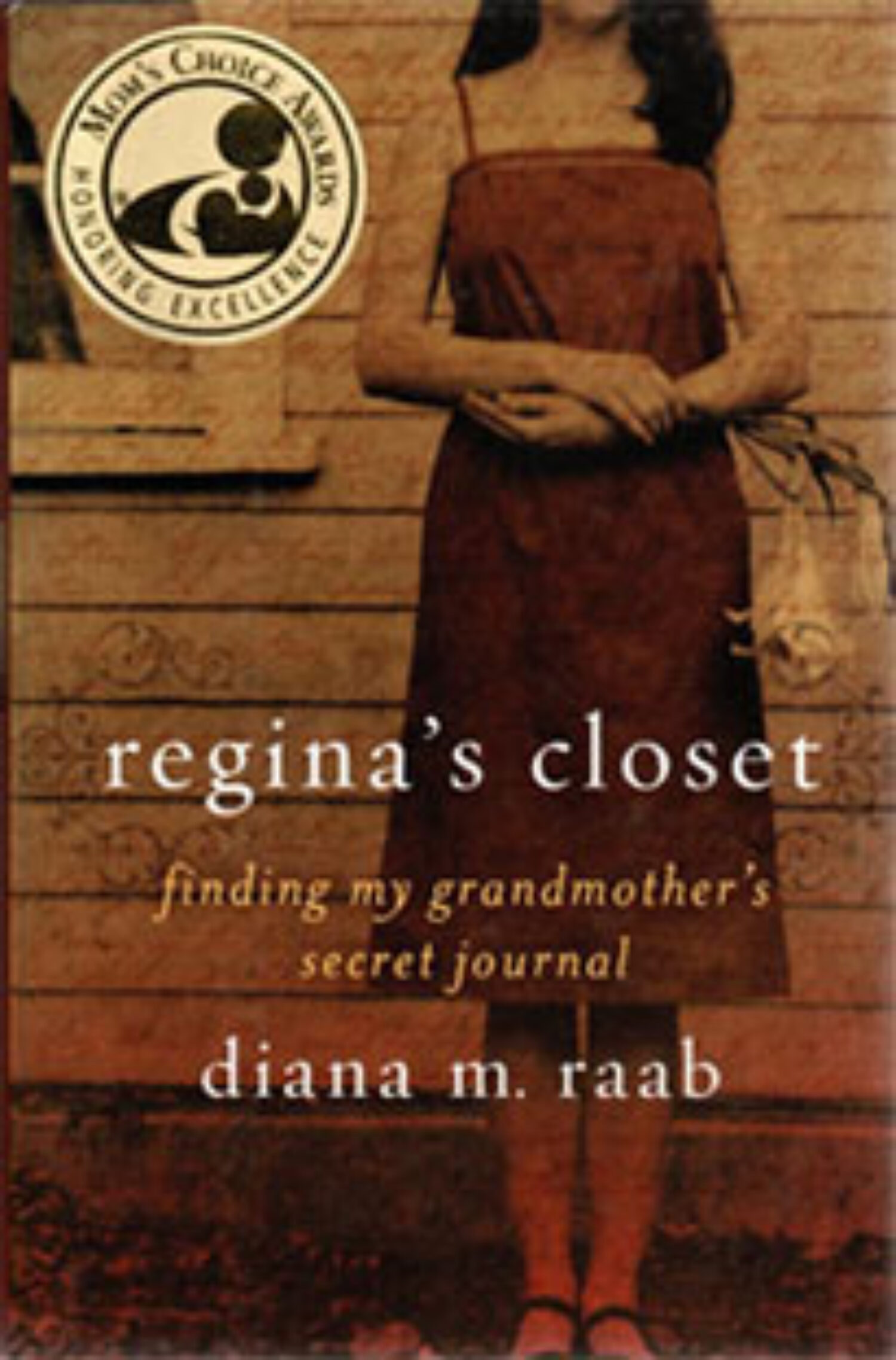
As the daughter in a family who immigrated in the 1930s from Europe, I have a slew of very interesting ancestors. If I had to pick one to highlight, it would be my grandmother, Regina. I actually studied her life in great depth for my memoir, REGINA’S CLOSET: FINDING MY GRANDMOTHER’S SECRET JOURNAL (Beaufort Books, 2007).

At the age of twelve, Regina was orphaned in Poland during World War I. Her mother, who she had to identify on the infirmary’s floor, died of cholera and her father, who could not handle the loss, died shortly thereafter. Regina was left to care for herself and her younger, then ten-year-old sister, as both of her older brothers fled to Austria. Losing both her parents caused Regina to grow up quickly. She continued to go to school while holding down a number of part-time jobs.

She later decided to move to Vienna to be near her brothers. She was able to work part-time in banks but all along her true passion was to become a doctor. However, she did not have the emotional or financial support to get into medical school. While still working at the bank, she decided to attend modeling school. This was where she met her husband, Samuel.

They married, and had one daughter, Eva, my mother. In 1937, just before World War II broke out, the three of them emigrated to the United States. She raised Eva and worked in Sam’s retail store. With her continuing passion for medicine, she decided many years later, in the early 1950s, to write a letter to the NYU Department of Medicine for admission. They immediately turned her away because she was a woman and she did not have any financial support. Regina continued to work at Sam’s retail store while still lacking an intellectual challenge.
At the time of my birth in 1954, she decided she wanted to become my caretaker because my mother wanted to work full-time. When I turned ten and started to show signs of independence, she no longer felt needed. The torments of her childhood were still deeply imbedded in her and these torments, coupled with my independence, resulted in her suicide in 1964.

Many years later and about the time my parents moved out of my childhood home, we discovered her journal. It was a retrospective journal depicting her life in Europe and being orphaned during World War I. This was the basis of Regina’s Closet. While writing the book, I realized the important role she played in my life as a writer. During the time when she took care of me, she taught me to write stories on her Remington typewriter which was perched on the vanity in her room. After reading her journal, I also realized that I had inherited her journaling gene, because for years, journaling has also been my passion. For all this and more I thank my amazing and intriguing grandmother.

Keeping Time : 150 Years of Journaling

A few years back I submitted some very personal journal entries to a proposed anthology. I was delighted to hear that Keeping Time: 150 years of Journal Writing edited by Mary Azrael and Kendra Kopelke was recently published. This is a rare collection of journal entries all under one cover. As the editors state in their poignant introduction, “For many people, journal writing is a private activity, spontaneous and revealing, not intended for an audience of strangers.” But these editors did a stellar job of putting together 37 wonderful pieces with subjects ranging from everyday life parental issues, raising children, nature, travel, health and historical events. “Keeping Time,” they go on to say, “stands as witness to the times spanning from our great grandparents to today. It opens a way into our history at its most intimately and sincerely felt, and expands our sense of what a notebook can do to connect us more fully to our lives.”

My submission represented the year 2001, and I have posted it below:

I have been keeping a journal since the age of ten. Over the years, my journal has been my friend and confidant to help me through difficult times. I strongly believe in the powerful healing qualities of the written word.
Today, I teach journaling to breast cancer survivors and high-risk teens. During my breast cancer journey, writing became my lifeline and a way to give voice to my deepest feelings.

The following is an excerpt from my memoir/self-help book, HEALING WITH WORDS: A WRITER’S CANCER JOURNEY.

August 22 (one-day post-op)
I wake up in the Intensive Care Unit (ICU) today and Simon sits beside me holding my hand. One part of me wants to look down at the hospital gown covering this corset-like gauze bandage around my chest. Yet another part of me is scared out of my mind. The nurse helps me to the bathroom and I avoid the mirror as if it holds the most dreaded secret. I want to rip it off the bathroom wall. I never want to see myself naked. While walking back to bed, I look over at Simon and begin sobbing with no respite. I know in my heart that one day soon I will have to look at my chest. My hope is that my plastic surgeon will make all the necessary explanations. I am happy that the surgery is behind me, but now I must begin preparing to walk down an even more arduous road. I must get used to the new me.

August 23
Today my mood oscillates back and forth. One moment I want to touch my newly-created breast and the next minute I never want to see it. I am pleased that the reconstruction was done immediately following the mastectomy. After breakfast, I pulled the nurse’s cord to help me sit up. I am terribly sore from being in one position. By the time she arrives moments later, I have already changed my mind. I put my hand over my right breast and feel nothing. I do the same on the left. I can only feel the slight pressure of my hand. How will I ever get used to having no sensations. My right nipple had always been more sensitive than and easily stimulated than my left, but now there is a sense of nothingness, numbness, a void.

Today the nurse removed the bandage around my chest. I looked the other way while crying into my pillow. I felt nothing. My plastic surgeon said some sensations might eventually return, but never again could I become sexually aroused on my right side. So, I have two breasts, but really only one. My sensations have been severed forever. Never again would I experience that sublime tingling when Simon runs his fingers over my rather large nipple—never again on that side. Never could I experience the joy and tingles from let-down reflex when my babies sucked for the first time. I loved that sensation which permeated my soul and brought me such joy.

August 27
The books I have read, and my nursing experience warned me that depression is common following many surgeries, particularly breast surgery, because of the huge psychological component of losing a breast. I should be optimistic because my breast surgeon says that the cancer has been removed. He says I am lucky that it did not spread into my lymph nodes. Yes, this is a true blessing, but there are moments when this is not enough to console me. My father taught me to look at the glass half full and not half empty. I’m trying. Really trying. But, this entire event has been surreal. My defenses are stripped. I have no strength left in my body except for the weeping. Tears flow like an endless river. They pour out without warning and dry up without notice.

August 28
I look around me and see all the technology. I think of my husband, an engineer, and how people like himself have made mine and so many others’ survival possible. He is a fixer. On so many other occasions he wants to quickly make everything better for me. His smile and touch are so healing. He has so much power, but he cannot bring my breast back to me. He says he wishes he had a magical wand to make me feel better. I tell him that the wand was discarded the day it brought him into my life. One person cannot be bestowed with any more luck than me. He implores me to think positively.

Sometimes life is not so simple. I don’t want to say this to him because he tries so hard to soothe me. It’s still early in my post-operative period, but I already feel physically and emotionally changed and drained. In some ways it is easier being far from home. My predicament somehow seems clearer and my mind less distracted by familiar surroundings.

September 3
Today I am nearly two weeks post-op. I do not feel any better emotionally than the day they rolled me out of the cold and sterile operating room. My emotional strength is barely returning. I still get teary-eyed for no obvious reason. This morning, the nurses bathed me. They helped me to the chair where I tried reading a magazine, but my mind wandered. Everything makes me cry, even glancing at the latest hairstyles in the magazine. I feel trapped inside this body that I don’t know anymore.

Here’s what I look like. On my right side is a drainage tube tucked into a hole beneath my mastectomy site. On the same side, another tube leads to the incision in my back where they have removed the muscle and tissue to cup my saline implants. The tube leads to this thing that looks like a hand grenade which dangles from my side. This grenade drains the blood from my wounds, but I think it does the same from my heart. It needs to be emptied three times each day. It’s gross and yet another reminder of my missing breast. When we go to dinner at the hotel’s restaurant, the only thing I can wear are baggy men’s shirts to hide my tube and stupid grenade.

Getting up and going to the bathroom is such an ordeal. I need at least ten minutes to prepare for the departure from my bed. Getting all the wires organized is truly a monumental task. I cannot lean on my back; the drainage tube sticks straight out. I cannot lean on my right side—another tube. They hurt like hell. There are no more comfortable positions left for me. Jeannine [mother-in-law] asked if I have been writing. She must be kidding! I have so much to write about, but I cannot focus. My mind wanders beyond belief. Life is fuzzy and not even eyeglasses can help. I am just plain frustrated. I can only muster these few words and even these exhaust all of my energy.

September 4
Today I will go visit my plastic surgeon. It seems as if the past couple of weeks have been surreal. A thick cloud suspends over me. How did I get here? I was diligent about my annual mammograms and check-ups. On the first day of my menstrual cycle I diligently did self-breast exams in the shower. There is no cancer in my family. Why am I lying here all mutilated?

I have never thought much about cancer, but one thing I know is that if cancer is in your body, you better get it out quickly. Having had reconstructive surgery at the same time as my mastectomy has put my mind at ease. Even though I have refrained from looking at myself naked in the mirror, there was a sense of relief to waking up with a mound on my right side, even if it was not my own breast, but just a sack of saline water.

September 6
I’m trying to take the position that cancer is no longer lurking inside of me. I did have cancer, but it is now all gone. All of it. I don’t like the sound of the term ‘breast cancer.’ People equate cancer with death. I refuse to die.
When I first learned about my breast cancer, I wanted to hear everybody else’s escapades and everyone’s medical sagas. It seems that everyone knows someone who has had breast cancer. This is not surprising since the statistics have now risen to one in eight women. Listening to other people’s stories is boring at times, and at other times scary. Sometimes it’s inspiring to learn that others are less fortunate than me. The woman in the corridor told me about her stage III cancer. Okay, she made me feel lucky, but I just don’t want to be surrounded by negative energy.

I am so afraid that the cancer will come back. I cry about losing the breast and also about having to lose my other one. Crying comes so easily. Sometimes the tears last a few minutes, other times an hour. It all depends.

Keeping Time is available from Amazon at the link below, and it is a wonderful read. I surely hope you take the time to order and read it.

http://www.amazon.com/Keeping-Time-Years-Journal-Writing/dp/0963138545/ref=sr_1_1?ie=UTF8&s=books&qid=1297999546&sr=8-1

Studying Ralph Waldo Emerson

Once in a while I will choose an author or poet to read about in some detail, typically because I am being called to them or because their name crosses my desk a few times within a short period of time.

This week, Ralph Waldo Emerson is that poet. I first stumbled upon his name while investigating a doctorate in Transpersonal Psychology and he was quoted on numerous occasions, mainly because he was part of the transcendental movement which began in the mid-nineteenth century. Transcendalism is at the core of transpersonal psychology which is orientated towards many streams of thought and experience—philosophy, religion and psychology. In fact, Abraham Maslow, who played a key role in the emergence of this new psychology, studied Emerson and viewed him as a self-actualizing person. Both Maslow and Emerson rejected organized religion and believed in the transcendent forms of love, goodness, justice and beauty, in a similar way that Henry David Thoreau and Walt Whitman did.

Speaking of Whitman, I just finished the wonderful book Collage of Myself: Walt Whitman and the Making of Leaves of Grass by Matt Miller where I learned about the poignant relationship between Whitman and Emerson. Emerson wrote Whitman one of the most famous letters written to an aspiring writer which gave Whitman the confidence to forge ahead with his work. You can view the letter on this website:

http://www.classroomelectric.org/volume1/belasco/whitman-emerson.htm

Just after finishing this book, I heard from a good friend that he had recently written an essay for Harper’s Magazine on Emerson called, “Between Insanity and Fat Dullness: How I became an Emersonian.” (January 2011). For a few months prior to writing the essay, Phillip Lopate submerged himself in Emerson’s recently published journals. Lopate’s poignant essay intrigued me on many levels, and I am grateful for his writing, since I do not believe I will be able to carve out the time to read the 1,900 pages of Emerson’s journals.

Lopate says Emerson began keeping his journals “as a dreamy would-be-poet.” He goes on to say that “the journals give us, in full, Emerson’s thinking about his life.” Lopate confesses that he was truly taken by Emerson’s life and how he has become a model for him on how to overcome anxiety and despair, while at the same time making resilience eloquent.

As a journal-keeper myself, I liked that Lopate pointed to the idea that Emerson’s journals revealed his most vulnerable side. I ask you, if you cannot be vulnerable while writing in a journal, then where can you be?
Emerson began keeping journals at the age of sixteen and he filled more than 182 volumes which until now, remained unpublished. Lopate eloquently declares that Emerson was “indeed the weatherman of his own consciousness, charting his moods just as he observed on walks the changing aspects of nature and sky.” He continues, “What I respond to most in Emerson is his even keeled preoccupation with daily life, the daily mental round, and with that his resistance to the bullying closures of the apocalyptic imagination.”

Lopate also discusses Emerson’s social side and how he tried to stretch himself to accommodate others and become larger soled and more responsive, a sentiment at the core of transpersonal psychology. He also revealed that Emerson oscillated between being enchanted and annoyed by his friend’s eccentricities. Interestingly, he worried that Thoreau’s going to jail was ‘one step to suicide’ and that his retreat to the woods might end in ‘want and madness.’ I also learned that Emerson was the one who inspired Thoreau to keep a journal.

I surmise that these wise men who studied transcendentalism were simply seeking spiritual guides who could lead them into their own personal futures. In the end, they decided that the spiritual guide or God (or whatever term you prefer) is within each of us and does not represent any external entity. I could not agree more profoundly.